
Last week, during an interview, the candidate asked me how I could move beyond my current technology and learn different marketing technologies. I also get this question a lot from some of my internal teams. So, here is what I think is the starting point to learning Marketing Technology. Before that, let me talk about my journey a little bit.
I started my career as a Java developer in 2010. During the first year, I learned technologies like Adobe Flex, SAP ABAP, front-end, and custom java applications. I integrated Adobe Flex with many backend systems like SAP, Salesforce CRM, and custom Apps. Later, I learned a new CMS called Communique (Day CQ)/Adobe CQ/Adobe Experience Manager. I found my home in AEM. I designed and architected AEM solutions for some of the biggest brands in the world. My next goal was to explore Digital Transformation, specifically in the Marketing technology domain. I enjoyed losing myself in the universe of MarTech, solving complex business problems, and architecting Digital Technology solutions for some of the Marquee clients. It was crucial to strengthen the core technology and learn for the future simultaneously. This article will discuss my path to expanding the technology horizon. Like enlightenment in life, you have to find your way. Here is mine. 😊
Step 1 – Understand the business side of Marketing.
Digital Marketing Transformation and Architect’s role
Digital Marketing Transformation starts with a business strategy to support the organization’s customer experience goals. It could start as simple as “I want to engage my customers better and personalize experience across channels” to replace the legacy platforms with the new-age MarTech Stack. Business value drives the digital transformation. There is no single point entry that an organization can take to start the transformation Journey. The role of an Architect is to understand the business goals, remove ambiguity, document the business architecture, design the architecture models and processes, and act as a bridge between the business and the IT teams.
Marketing Domain and Terminology
Digital marketing is a vast subject but an important one. For a MarTech architect, understanding the marketing domain and terminology is the first step on the journey. Mainly, I recommend starting with the below list.
- Learn how clients/organizations use digital marketing to meet their business goals.
- Understand different roles in the marketing department and the challenges.
- How Ads and AdTech work! (Super exciting topic and a complex one)
- Different marketing types like Content Marketing, Email Marketing, Affiliate Marketing, SEO Marketing, etc.
- Digital channels.
- MarTech and AdTech glossary. Here is a link I found on the web. https://resources.lotame.com/hubfs/~Lotame.com%20Content/Lotame_AdTech_MarTech_Glossary.pdf
Challenges in Digital Marketing business
The digital channel burst has introduced new challenges to digital marketing. For an architect, it is imperative to understand not only the goals of the business but also the current and future challenges. The solution should also accommodate the core traits of any software architecture – scale, security & privacy, reusability/modular, and reliability.
Step 2 – Marketing Technology Components
There are more than 10000+ marketing technologies/apps separated into multiple categories. In this section, I want to list some of the most commonly used components in the MarTech ecosystem. It is critical to understand the role, concepts, and integrations of each of the elements.
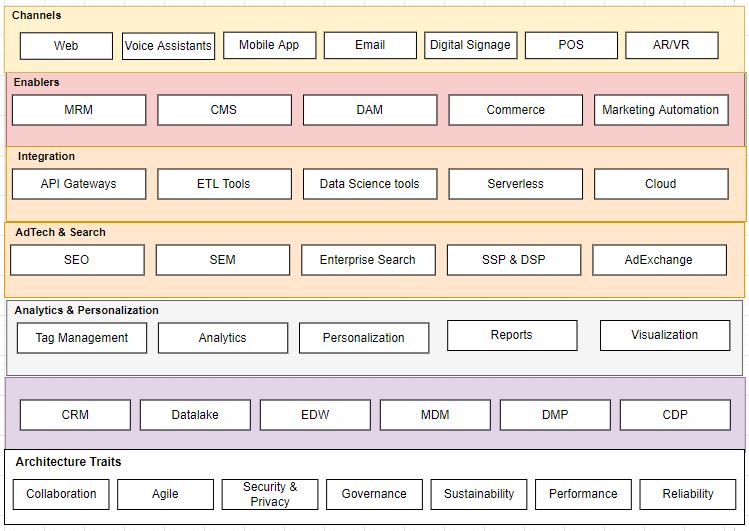
Data
Key topics to understand:
- (Unified) Customer profiles and stitching
- Customer journey mapping
- Cross-channel identify resolution
- Customer preference management
- Data sources
- Data ingestion methods and processing
- Schema modeling
- Audience segmentation
- Data activation and channels
- ETL process and tools
- Importance of first-party, second-party, and third-party data
Analytics & Personalization
Key topics to understand:
- Standard KPIs to track in analytics
- Importance of data layer
- Tag management capabilities and how it ties different tools together.
- Standard reports and visualization dashboards
- Different personalization types.
- Audience segmentation.
AdTech and Search
Key topics to understand:
- DSP, SSP, AdExchange.
- Different AdTech strategies.
- Retargeting strategies.
- How DMP is used to personalize the ad experience.
- SEP, SEM, and Search.
Integration
Key topics to understand:
- API Gateways to integrate different platforms.
- Serverless concepts.
- OOTB integration capabilities of each platform.
- Platform connectors
Enablers
Key concepts to understand:
- Use of MRM to plan, track and execute marketing campaigns.
- CMS concepts and its role in activating the content across marketing channels
- DAM and Its integration with MRM, CMS, and other channels.
- Learn Marketing automation capabilities and its integration with CDP, CRM, etc.
Channels
Key concepts to understand:
- How different platforms cater to channels.
- Unique challenges each channel brings.
- Challenges faced by brands to track a customer across channels.
Architecture Traits
Each MarTech component should abide by architectural traits like agility, security & privacy, data governance, performance, and sustainability.
Remember – A great solutions architect lives in the future. They design a system for now that sets the company up for success in the future.
Step 3: Connecting the Dots
Digital experience delivery is a team sport. Once you understand each player’s role, it’s time to play the game.
- Learn how brands use AdTech to acquire new customers by showing personalized ads using data.
- Learn about customer journeys and different touchpoints customers use to interact with brands
- Understand how marketers use technologies (each of the above components) to respond to each customer interaction.
- Understand how data is captured, processed, and activated to different activation channels for personalization and communication.
- How analytics captures customer behavior across channels, and marketers use that data to plan future campaigns.
- Understand how the customer and marketer journey differs for B2C and B2B.
Last but not least is the research on different technology vendors, their offerings, and the space leaders. Pick a vendor, apply the above steps and start your journey. Go!

 Rahul Mengji
Leave a comment